


Manual Wheelchair or Rollator?
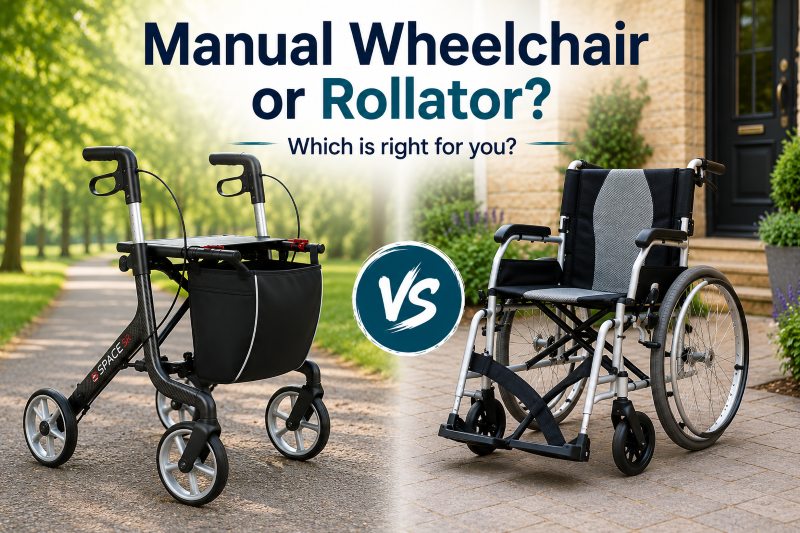 A short walk to the front door can feel very different depending on the support you have beneath you. If you are weighing up a manual wheelchair or rollator, the right choice is rarely about what looks simplest - it is about how you move, how far you need to go, how confident you feel on your feet, and how much independence you want to keep in day-to-day life.
For some people, a rollator is the step that makes getting out and about feel manageable again. For others, a manual wheelchair offers the comfort, safety and energy-saving support that walking aids cannot. The challenge is that both can be useful, but they solve different problems.
Manual wheelchair or rollator - what is the real difference?
A rollator is a walking aid with wheels, handlebars and usually a built-in seat. It is designed for someone who can still walk but needs extra balance, support or a place to rest. You propel it forwards as you walk, and it helps reduce strain while giving you something steady to hold onto.
A manual wheelchair is intended for someone who cannot walk far, cannot walk safely, or would become too fatigued by walking even with support. It can be self-propelled by the user or pushed by a companion, depending on the model and the person using it.
That distinction matters. A rollator supports walking. A manual wheelchair replaces walking for longer distances or when walking is not realistic. If you still have enough strength, balance and confidence to walk safely, a rollator may help you stay active. If walking is causing pain, instability or exhaustion, a wheelchair may be the kinder and more practical choice.
When a rollator is often the better fit
A rollator can suit people who are mobile but slower, less steady or more easily tired than they used to be. Many customers choose one because they want to remain upright and active without feeling as though every trip outside the house is a struggle.
It can be especially helpful if you find that your legs are still capable, but your balance has changed. Conditions affecting stamina, mild weakness, joint pain or recovery after illness can all make a rollator a sensible option. The seat is a real advantage here. It gives you the freedom to stop and rest rather than cutting an outing short.
There is also a psychological side to this choice. Some people feel more confident using a rollator because it allows them to carry on walking in a familiar way. That can be important for routine, confidence and overall wellbeing.
The trade-off is that a rollator only works if walking is still safe. If you are putting too much body weight through the handles, shuffling with difficulty, or feeling likely to fall even while using it, a rollator may no longer be enough support.
Signs a rollator may suit you
If you can walk independently but need help with steadiness, pacing or rest breaks, a rollator is worth considering. It can also be a good choice if you want something lighter and easier to transport than a wheelchair, particularly for short trips, appointments or shopping.
That said, not all rollators are equal. Handle height, wheel size, brake performance and folding design all affect day-to-day comfort and safety. A poorly fitted rollator can encourage poor posture and make walking harder.
When a manual wheelchair may be the better choice
A manual wheelchair often becomes the right option when conserving energy matters just as much as getting from one place to another. If walking leaves you in pain, breathless, unsteady or exhausted, relying on a rollator can sometimes mean pushing through when your body is telling you to stop.
Wheelchairs are not only for people who cannot walk at all. They are often used by people who can manage a few steps indoors but struggle with longer distances, uneven pavements, hospital visits, shopping centres or days out. In those situations, a wheelchair can make life more accessible rather than more limited.
This is particularly true for people recovering from surgery, living with neurological conditions, coping with severe arthritis, or experiencing fatigue linked to heart, lung or musculoskeletal problems. The right wheelchair can reduce effort, improve comfort and make it possible to participate in everyday life again.
There is sometimes hesitation around moving to a wheelchair because it can feel like a bigger step. In practice, many people find it brings relief. Instead of planning every outing around how much walking they can cope with, they can focus on where they want to go.
Signs a manual wheelchair may suit you
If your walking is unsafe, very limited or only possible for short distances, a wheelchair may offer more reliable support. It is also worth considering if you are avoiding outings because of fatigue, pain or fear of falling, or if a family member is becoming concerned about how much effort each trip takes.
The practical detail matters here too. Some people need a lightweight transit chair for occasional use with a carer. Others need a self-propelled wheelchair with larger rear wheels and a seat size that properly supports posture and comfort.
The question most people should ask first
Rather than asking, “Which is better, a manual wheelchair or rollator?” it is often more useful to ask, “How do I move on my best day, and how do I move on my worst day?”
That is where many decisions become clearer. If you only think about your better days, you may choose equipment that is too limited when you really need support. If you only think about your worst days, you may choose something that feels more restrictive than necessary.
An honest answer usually sits somewhere in the middle. You may walk well enough around the house but need more support outdoors. You may manage with a rollator for local trips but need a wheelchair for longer excursions. It does not always have to be one or the other for every situation.
Manual wheelchair or rollator for indoors and outdoors
Your home environment plays a big part in the decision. A rollator may be easier to manoeuvre around familiar indoor spaces if there is enough room and the flooring is smooth. It can also help with carrying light items and moving between rooms while staying on your feet.
A manual wheelchair needs enough turning space, suitable door widths and practical access around furniture. If your home is compact or has awkward thresholds, that may affect which model works well.
Outdoors, the picture changes. Rollators can be excellent on pavements and in shops, but rough ground, steep slopes and uneven surfaces can make them harder to control. A wheelchair may provide more consistent support over longer distances, though pushing it manually can still take effort depending on the terrain and the strength of the user or companion.
This is why trying equipment in realistic settings can be so valuable. What feels comfortable in a showroom may feel different on a kerb, a driveway or a high street.
Comfort, transport and everyday practicality
Comfort is not a small detail. If a seat is too narrow, handles are too low, footrests are awkward or the walking position feels unnatural, you are less likely to use the equipment properly. Over time, that can affect confidence and independence.
Transport is another deciding factor. Many people need equipment that folds easily into a car boot and is manageable for a partner or family member to lift. Rollators are often lighter and quicker to fold. Manual wheelchairs vary a great deal - some are relatively light, while others are more solid and better suited to regular, longer use.
It is also worth thinking about how often the equipment will be used. For occasional appointments, a simple setup may be enough. For daily use, details like padded seating, adjustable parts and ease of handling become far more important.
Why advice matters more than guessing
Mobility equipment is not just a purchase. It affects safety, comfort, routine and confidence. Choosing based only on appearance or price can lead to frustration, especially if the aid does not match the user’s actual needs.
A proper conversation can uncover things that are easy to miss - whether the user has enough grip strength for brakes, whether posture is likely to be affected by the seat, whether they will self-propel, and whether the aid needs to work in tight indoor spaces as well as outdoors. These points are often what decide whether equipment sits unused or becomes a genuine help.
At Cavendish Health Care & Mobility, this is exactly why taking time over the decision matters. The best solution is usually the one that fits the person’s lifestyle, home and confidence level, not simply the one that seems most familiar.
If you are still unsure
If you are torn between a rollator and a wheelchair, that uncertainty is completely understandable. Many people are not choosing between two products so much as choosing how they want to live day to day - how far they can go, how safe they feel, and how much energy they want to spend getting there.
The right mobility aid should make life feel more possible, not more complicated. If walking is still safe and practical, a rollator may help you keep doing more for yourself. If walking has become a barrier, a manual wheelchair can remove that barrier and make outings feel comfortable again.
The best starting point is an honest look at what your body needs now, not what you wish it could still manage. From there, the right choice tends to feel much clearer.
Recent Blogs
- New to Cavendish Health Care: The AVIVA RX10 Power Chair
- How to Use Bath Boards Safely and Comfortably
- When Wheelchair Repairs Need a Specialist
- What Wheelchair Width Do I Need? A Simple Guide
- Stairlift or Home Lift: Which Is Right for You?
- How to Choose the Best Portable Mobility Ramps
- Can Riser Recliners Help Circulation at Home?
- Bathroom Safety Aids Guide for Safer Daily Living
- What Is a Bespoke Riser Recliner Chair? Goldilocks and the Three Chairs
- Which Wheelchair Cushion Helps Pressure Sores?
- Choosing the Right Mobility Scooter Rain Cover
- How to Choose Grab Rails for Safer Living
- Lightweight Transit Wheelchair Review for Everyday Use
- How to Pick a Shower Stool That Feels Safe
- How to Choose a Mobility Scooter Repair Service: A Checklist & Review Guide
- Best Commodes for Home Use: What to Choose
- Choosing Triple Motor Riser Recliner Chairs
- 12 Best Daily Living Aids for Arthritis
- Home Mobility Assessment Guide for Safer Living
- Bathroom Mobility Aids Trends in 2026
- How Cavendish Health Care Waterlooville Puts Customers First
- What Bathroom Aids Prevent Falls at Home?
- Getting the Right Fit from Your Rollator
- Rollator or Walking Frame: Which Fits Best?
- Triple vs Quad Motor Riser Recliner Chairs
- 10 Top Daily Living Aids for Easier Days
- How to Choose the Best Riser Recliner Chairs
- Best Walking Aids for Balance Explained
- Profiling Bed Buying Guide for Home Use
- Do Mobility Scooters Need Servicing?
- Drive AeroCarbon: A Lightweight Folding Mobility Scooter Built for Modern Travel
- How to Choose a Rollator That Fits You
- Are Riser Recliners Good for Arthritis?
- A Practical Mobility Scooter Repair Checklist
- Monarch Supa Carbon Lite: A Lightweight Carbon Fibre Mobility Scooter Built for Travel
- Top Riser Recliner Chair Features to Look For
- Wheelchair Seating Guide for Better Comfort
- How to Clean Riser Recliners Properly
- Manual Wheelchair or Rollator?
- Making Your Home Safer When Living with Parkinsons
- Best Mobility Scooters for Seniors
- What Do Mobility Scooters Cost in the UK?
- A Different Definition of Independence
- From Pavements to Parks: Testing Rollator Durability for an Active Lifestyle
- Beyond Three Wheels: Choosing the Best 4-Wheeled Rollator for Parkinsons Safety
- April is Parkinsons Awareness Month: Reclaiming Your Daily Walk
- Cavendish MS Society Fundraiser Week in Waterlooville
- Supporting Accessible Travel at the Yes You Can Travel Event
- Wheelchair Servicing From 45 pounds Throughout March at Cavendish Health Care
- The 10-Second Transformation: Why Folding Powerchairs are Changing the Game
- Real World Manoeuvrability Dont Let Narrow Doorways Hold You Back
- Hampshire DFG Funding Boost: 50M Pounds Extra for Home Adaptations
- A Valued Thank You from Mr Garbutt
- Rediscover Your Sense of Adventure at the Yes You Can Travel and Adventure Day in Denmead
- A Guide to Mobility Milestones: When Is It Time to Upgrade to Electric?
- Yes You Can Travel & Adventure: Supporting Independence Beyond the Home
- The 2026 Mobility Review: How Proposed Law Changes Could Affect Your Scooter or Powerchair
- How the 2025 Autumn Budget Could Shape Everyday Life for Mobility Equipment Users
- Choosing The Right Mobility Aid: Your Ultimate FAQ Guide to Walkers, Rollators & Scooters
- Stay Mobile This Winter in Portsmouth & Waterlooville: 5 Essential Tips
- Helping Portsmouth & Waterlooville Hospital Patients Get Home Sooner
- A Lifetime of Service: My Mums Dedication to the Poppy Appeal
- Choosing the Right Mobility Aids After Hospital Discharge
- Sleep Better This Winter with an Adjustable Bed
- How to Make Your Garden Accessible with Mobility Aids
- How to Keep Warm and Dry on Your Mobility Scooter or Powerchair
- How The Right Mobility Scooter Transforms Independence: From Holidays to Everyday Life
- Hospital Discharge Support: Fast, Flexible Mobility Equipment Hire
- Stiltz Home Lifts: The Smarter Platform Lift for Independent Living
- Mobility Scooter Upgrade: How the Di Blasi R30 Fixes Old Flaws
- VAT Relief on Mobility Aids: Why Pricing Transparency Matters More Than Ever
- Do You Need Mobility Scooter Insurance? 6 Reasons to Consider Cover
- Walking Aids Explained: Types, Features & Benefits
- Stay Safe: Essential Bathroom Aids to Prevent Slips and Falls
- Embracing Life with Reduced Mobility
- Wheelchair Exercises and Tips to Stay Active and Social
- The Benefits of a Home Mobility Scooter Demonstration by Cavendish Health Care
- What to Do If Your Mobility Product Breaks Down: A Step-by-Step Guide
- What to Consider When Buying a Mobility Scooter
- Understanding the Journey of Mobility Aids
- How a SupaScoota Spartan has given me my freedom back
- Cavendish Health Care Maintenance Tips for Supascoota Mobility Scooters
- Accessible Walks in West Sussex
- Walking Stick Guide: Conquer Stairs with Ease and Confidence
- Struggling with stairs? Use our Walking Aids specifically designed for stairs
- Adjustable Beds - Experience Unparalleled Mobility
- Looking for a bathroom mobility aid?
- The benefits of a home demonstration
- Exploring Dorset's Charm: Accessible Walks for All Abilities
- Are you searching for a super light mobility scooter?
- Electric powered wheelchairs (Powerchairs)
- Discover Nature's Beauty: Accessible Walks in Devon for All Abilities
- Mobility Equipment: Buying Online vs In-Store
- Best Lightweight Car Boot Mobility Scooters for 2023
- What to expect from a home demonstration
- SupaScoota Sprint: Made to be a Portable Mobility Scooter
- Comfortable & Healthy Seating in your Rise Recliner Chair
- Why we're big fans of the V8 iLiving folding mobility scooter
- Benefits of an Adjustable Bed | Personalised Comfort for Better Sleep
- Staycation Travel Scooters for Summer 2022
- Best Car Boot Mobility Scooters for 2022
- Less than four weeks until Christmas
- Spotlight: The SupaScoota Spartan
- Would you buy a mobility scooter if it could...
- Buying Online vs Buying Offline Which is right for you?
- Help Around the Home | Living Aids | Accessibility
- Weather Protection Accessories for You and Your Mobility Scooter
- Mobility Scooter Maintenance in 5 Easy Steps
- Portable Mobility Scooters: What are your options?
- A Brief History of the Wheelchair
- Cavendish Health Care & Mobility will be at Naidex 2020
- Driving Miss Daisy: Assistance for People with Mobility Needs
- Christmas Gift Ideas for those with Limited Mobility
- The Highway Code for Mobility Scooter Users
- World Restart a Heart Day | Awareness
- How to Exercise if you have Limited Mobility
- SupaScoota Travel Adventures | Mr Roper's Experience
- Exploring the world of Wheelchair Tennis?
- Mobility Showroom in Hampshire | Cavendish Health Care & Mobility
- Stephen Hawking's Wheelchair to Sell in Online Auction
- A new 'life changing app' for disabled train users
- How to Prevent Mobility Scooter Theft
- Four Easy Ways to Get your Mobility Scooter into your Car Boot
- Accessible Walks for Everyone to Enjoy in Hampshire
- Is this the most versatile powerchair range in the UK?
- Torquay Showroom | Mobility Scooters, Wheelchairs, and More
- On Holiday at Euro Disney with the i3 Mobility Scooter
- Cavendish Healthcare's recommendations for World Book Day!
- 6 Reasons to Buy a Portable Mobility Scooter
- Travelling with a Lithium-Ion Battery
- Relax with our Top Range of Bathing Accessories
- 7 Top Reading Aids
- Guide to Riser Recliner Chairs
- Thank You for Supporting our Macmillan Coffee Morning
- The Able Label range of clothing
- Meeting our Easter Competition Winner at Winscombe Care Home
- Flight Friendly Lithium Batteries